
Blog > Buying Guides > Front Door Lighting
How to Choose Front Door Light Fixtures for Your Modern Home
June 26th 2026 | 26 Minute read
Still need help?
Phone Monday to Friday, 9 AM to 8 PM ET. Chat 7 days a week.
Blog > Buying Guides > Front Door Lighting
June 26th 2026 | 26 Minute read
Phone Monday to Friday, 9 AM to 8 PM ET. Chat 7 days a week.
The front door is the most important threshold in the home. It is where the street ends and the residence begins, where guests form their first impression, where the family arrives home every day, and where the visual identity of the property makes its clearest statement. The lighting that frames that threshold shapes all of those experiences, every single evening.
Most homeowners choose front door lighting last, treating it as an afterthought once the more interior decisions are settled. This is a significant reversal of the correct priority. No other exterior fixture has as much influence over how a home looks and feels after dark. A well-chosen, properly scaled, and correctly placed pair of wall lights transforms the arrival experience in a way that landscaping, paint, and even architecture cannot fully achieve independently.
This guide covers every decision that matters: scale, placement, brightness, colour temperature, single versus paired fixtures, and how to match lighting to different architectural styles. It is structured to produce a confident, informed purchase, not a second-guessing one.
For visual inspiration on what is possible before working through the specifics, browse our front porch lighting ideas first.
Use this table as a practical starting point before reading further. Match your entry type to find the right fixture category, approximate size, and atmosphere goal.
| Entry Type | Recommended Fixture | Suggested Height | Ideal Atmosphere |
|---|---|---|---|
| Small front entry | Single wall sconce | 30 to 40 cm tall | Warm and intimate |
| Standard front door | Pair of wall sconces | 35 to 50 cm tall | Welcoming and considered |
| Double door entry | Pair of larger wall lanterns | 50 to 65 cm tall | Bold and symmetrical |
| Covered porch | Overhead pendant plus sconces | Pendant plus 40 cm | Layered and luxurious |
| Modern minimalist home | Slim geometric wall lights | 35 to 50 cm tall | Clean and architectural |
| Large luxury entrance | Tall lanterns or column mounts | 65 to 90 cm tall | Grand and impactful |
A home that is unlit at the front door is a home that has, in effect, hidden its entrance. The architectural care that went into the door design, the material of the facade, the quality of the hardware: all of it disappears after dark if the lighting is absent or inadequate. Conversely, a front entrance that is lit with intention becomes more characterful and more beautiful after dark than it is in daylight.
The front entrance also serves a security function that is distinct from the aesthetic one. A well-lit entry discourages opportunistic crime, allows visitors to be identified safely, and makes the transition from the street to the door comfortable and confident rather than hesitant. Good front door lighting achieves both functions simultaneously without any tension between them: a warm, atmospheric wall light is also a practical and effective security light when positioned correctly.
Beyond aesthetics and function, front door lighting is one of the strongest signals of design quality available on the exterior of a home. The choice and placement of exterior wall lights tells a visitor, instantly and before they have seen anything else, what level of care and intention has gone into the property.
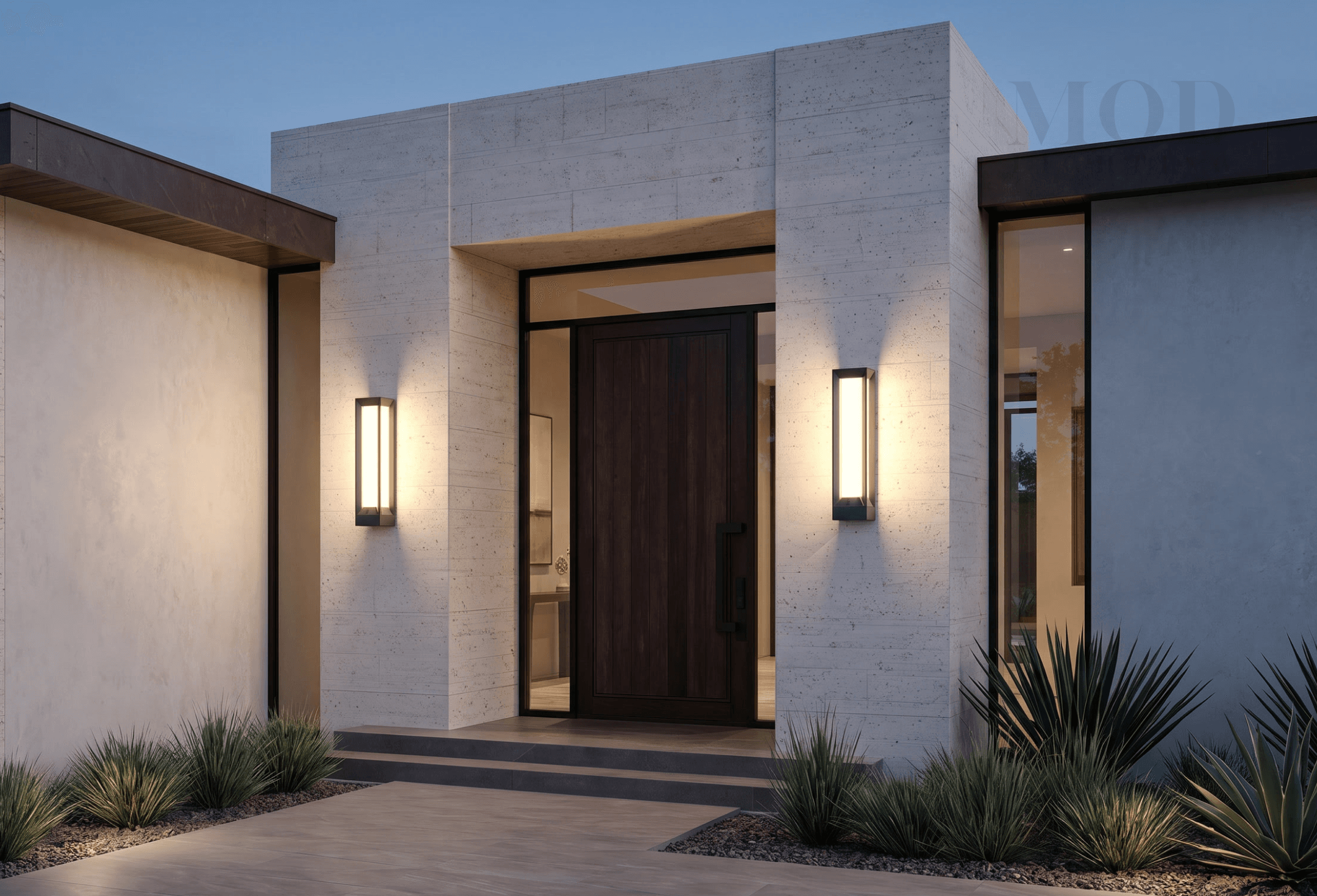

The governing principle for front door lighting selection is that the fixture should extend the architectural language of the home rather than contradict it. A contemporary home with clean lines, flat rooflines, and minimal ornament calls for fixtures with geometric precision and refined finishes. A home with more traditional proportions, natural stone or brick detailing, and a pitched porch calls for fixtures with more character, craft, and classic form.
This principle sounds straightforward but it is where most front door lighting errors begin. A beautifully made lantern placed on a deeply contemporary facade looks incongruous and slightly apologetic. A sleek minimal sconce on a traditionally proportioned Victorian terrace looks as though it arrived from a different property. The fixture should belong to the home it serves.
Before selecting any fixture, identify the two or three dominant characteristics of your home's facade: the material palette, the proportion of the door and surrounds, the style of any existing hardware or metalwork, and the general design era the property represents. The fixture decision follows from those characteristics rather than from personal preference alone.

Scale is the most consequential decision in front door lighting and the most frequently misjudged. An undersized fixture at a full-height door reads as tentative and disproportionate, regardless of its quality. An oversized one crowds the facade and creates visual imbalance. The correct scale is determined by the door, not by personal preference or the size of the product page photograph.
For a standard exterior wall sconce positioned beside a front door, the fixture height should be approximately one quarter to one third of the door height. A 210 cm door calls for fixtures between 53 and 70 cm tall. A taller or more imposing door calls for fixtures toward the upper end of that range or above it.
As a secondary confirmation, stand at the street and look at the door as a complete composition: door, surround, and any glazing above it. The fixtures should feel substantial enough to be in conversation with the door rather than subordinate to it, but not so prominent that they compete with it. When in doubt, size up. Undersized exterior wall lights are the predominant error in residential front entrances.
Mounting height also affects the perceived scale of a fixture. A fixture mounted lower than ideal looks smaller than its actual dimensions suggest; one mounted at the correct height reads as the size it actually is. Confirm mounting height before selecting fixture size to ensure the two decisions are made in the right relationship to each other.
Find correctly scaled exterior wall lights: browse the MOD outdoor wall lights collection for fixtures suited to every door proportion.
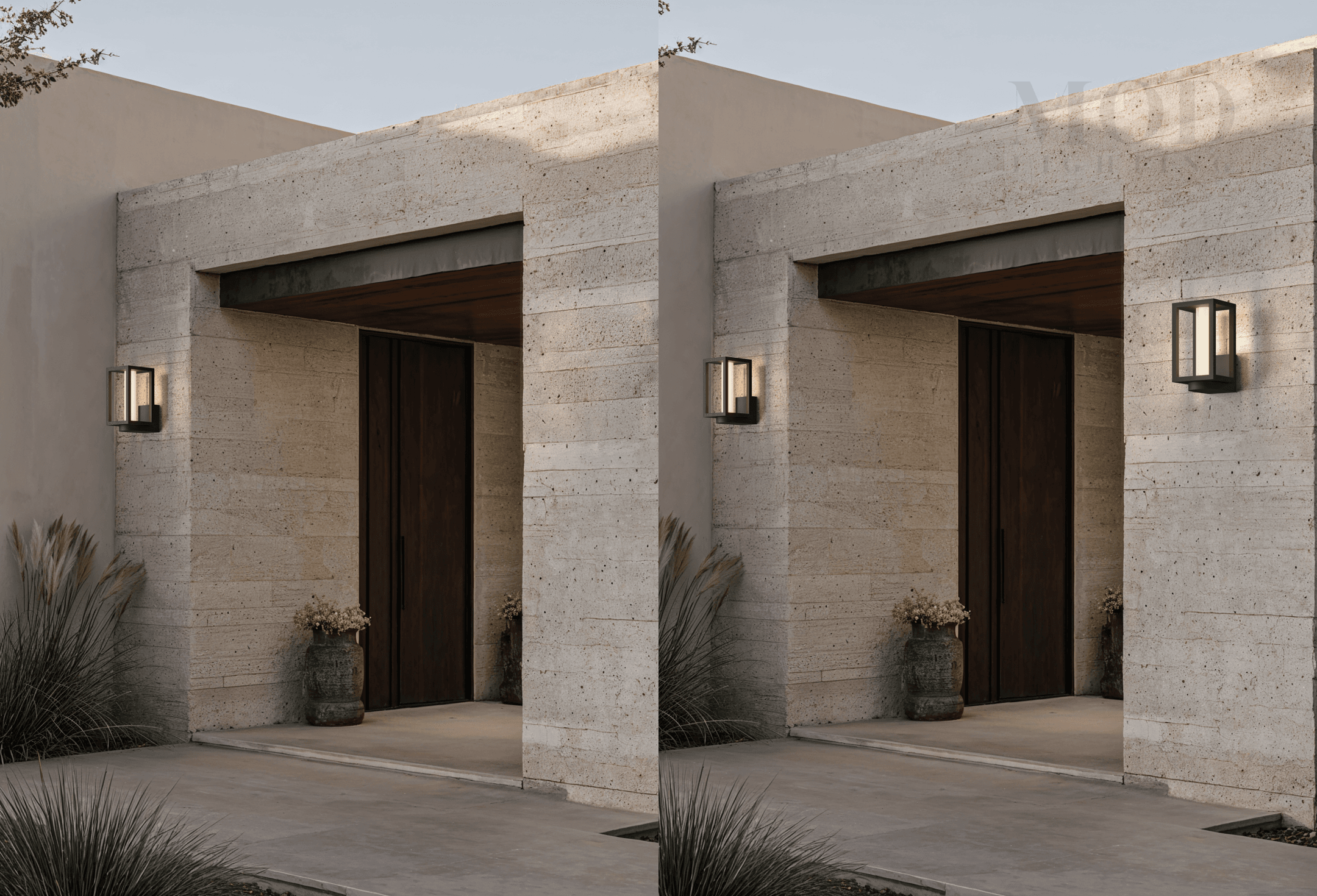
For most front doors, two wall lights flanking the door will produce a more resolved, more balanced, and more welcoming result than a single fixture. Flanking sconces frame the door symmetrically, distribute light more evenly across the entrance, and create a clear visual statement that reads as designed rather than functional.
A single fixture above or beside the door is appropriate for very compact entrances, for homes where the door is positioned so that only one wall is available, or where the architectural approach is deliberately asymmetrical and a single fixture is consistent with that intention. In all other cases, two is the better choice.
When using two fixtures, centre each one on the side panel or pilaster beside the door, at a consistent height on both sides. An asymmetrical placement at the same height on unequal wall surfaces requires careful measurement to ensure the two fixtures read as a deliberate pair rather than an accidental near-match.

Front door lighting does not need to be bright to be effective. The goal is not to illuminate the street or eliminate all shadow from the facade: it is to make the entrance clearly visible, safe to approach, and genuinely welcoming. Those three requirements are met at a considerably lower lumen output than most homeowners initially assume.
For a standard front door with two flanking wall lights, 400 to 700 lumens per fixture provides warm, welcoming coverage without creating glare. For a larger or grander entrance, or where the lights also serve as the primary security source for the path approaching the door, 700 to 1,000 lumens per fixture is appropriate.
The practical recommendation is to install dimmable fixtures wherever possible. A dimmable front door light can be set to a warm, atmospheric level for evenings and raised to full output when maximum visibility is needed. It is also consistent with the correct approach to every other residential lighting installation: the ability to adjust output across different moments of the day is always more valuable than a fixed high-output setting.
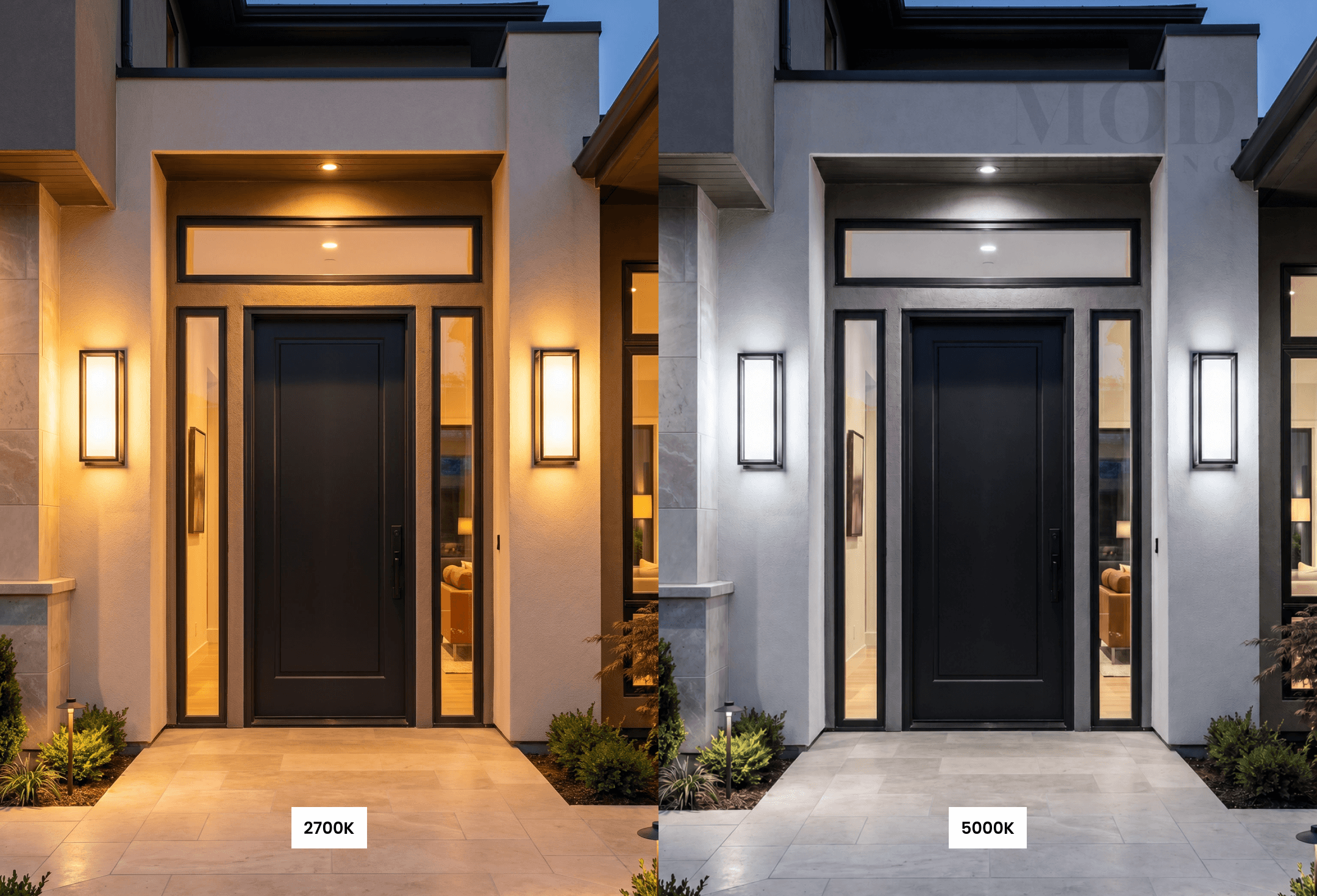
Colour temperature is the single decision with the most immediate impact on the atmosphere of a front entrance, and the one most commonly made by default. The difference between a home lit at 2700K and one lit at 5000K is not a subtle tonal variation: it is the difference between a home that looks warm, welcoming, and luxurious and one that looks cold, institutional, and uninviting.
Warm white at 2700K to 3000K is the correct choice for the front entrance of a residential property without exception. It flatters every material: stone, brick, render, timber, and painted surfaces all read as rich and warm under warm white light and as flat or bleached under cooler tones. It creates the sense of welcome that a front entrance is meant to convey, and it is consistent with the light quality most associated with home, comfort, and arrival.
Cool white above 4000K belongs in commercial environments. In a residential entrance, it signals the wrong things: efficiency over welcome, function over atmosphere. If security is the reason for choosing cool light, it is an unnecessary trade-off. A warm-toned motion-activated fixture provides the security function without sacrificing the atmosphere that defines a well-designed entrance.

Mounting height is the variable most frequently set incorrectly and the one that most visibly undermines an otherwise good fixture choice. A well-proportioned fixture mounted at the wrong height reads as an error that no amount of finish or quality can correct.
The standard guidance for exterior wall lights flanking a front door is to position the centre of the fixture at approximately 150 to 180 centimeters from the ground. This places the light source at or slightly above eye level for most adults, which is where it needs to be to illuminate the approach, the visitor, and the entrance effectively without creating downward glare onto the threshold.
For taller doors, grander proportions, or statement fixtures with significant vertical height, mounting can be adjusted upward accordingly. The key relationship to preserve is between the centre of the fixture and the midpoint of the door: on most standard doors, a fixture centred at 150 to 165 centimeters will align with the mid-zone of the door, which is the most visually balanced mounting position.
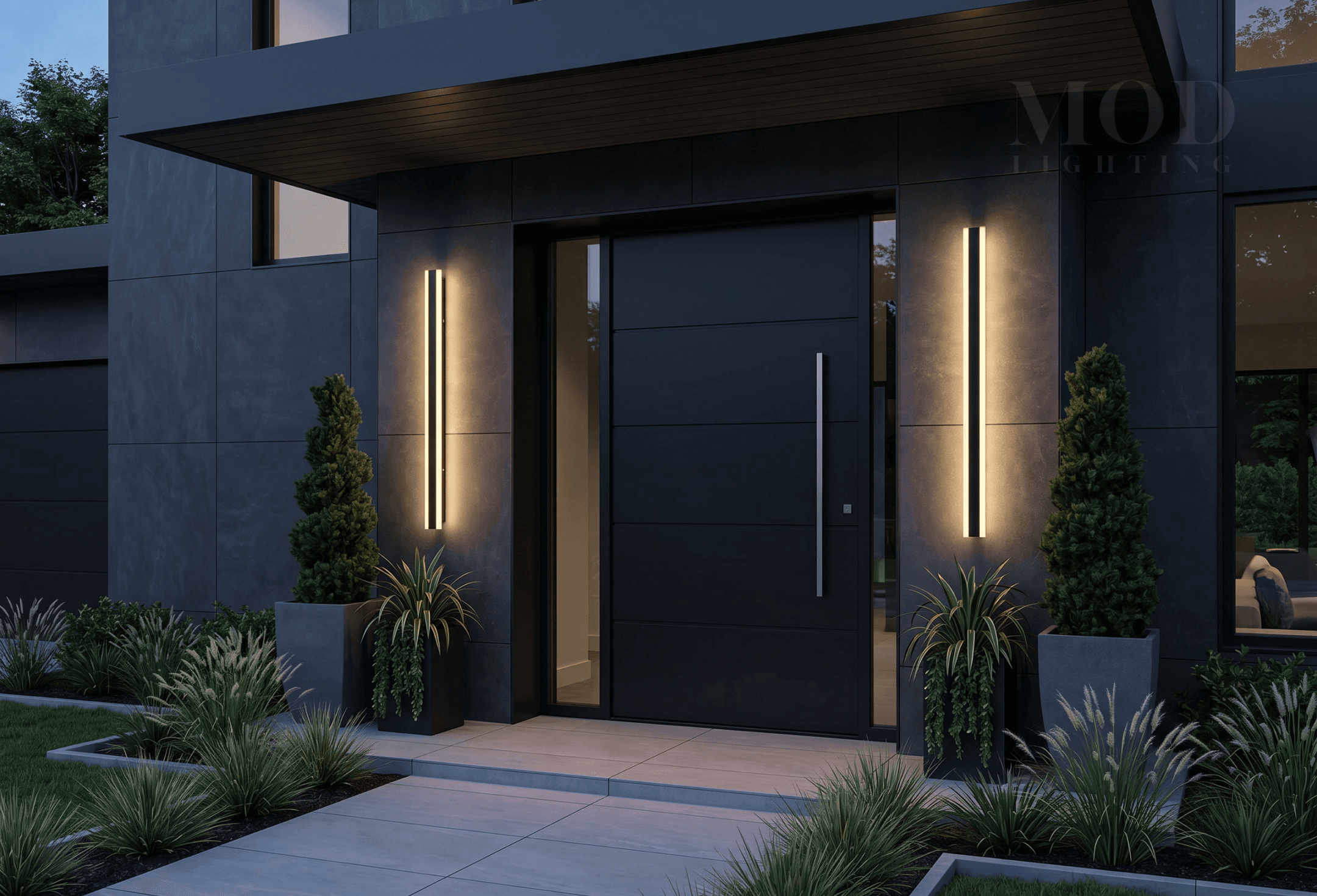
Modern and contemporary homes require exterior fixtures with the same qualities that define the architecture: precision, restraint, and material honesty. The fixture profile should be clean and resolved, with no ornamental detail that conflicts with the architectural clarity of the facade.
Slim vertical wall lights in matte black, brushed bronze, or architectural steel work consistently well on contemporary exteriors. Geometric lantern forms with minimal internal hardware, or solid body sconces that direct light upward or downward without decorative flourish, belong to the same visual language as flat rooflines, large-format glazing, and flush facade materials.
The finish choice is particularly important for modern exteriors. Matte finishes read as more considered and less reflective than polished ones, which suits the restrained aesthetic of contemporary architecture. Brushed or satin metals add tactile quality without visual noise. Avoid antique or distressed finishes, which signal a different architectural era entirely.
For modern exterior wall lights suited to contemporary architecture, browse the MOD outdoor lighting collection to find fixtures designed for exactly this context.

Homes with traditional proportions, period detailing, or natural material facades accommodate a wider range of fixture styles, from classic lantern forms to more transitional designs that blend traditional shape with contemporary finish. The key is that the fixture should feel proportionally and materially at home on the facade rather than imported from a different aesthetic.
Classic lantern forms in aged brass, antique bronze, or black iron work reliably on traditionally proportioned homes. The lantern silhouette echoes the scale and weight of traditional architecture and reads as appropriate rather than stylistically incongruent. Clear or seeded glass within those forms adds visual interest without competing with the architectural detail of the facade.
Traditional homes also offer more opportunity for fixture scale. Where a contemporary home requires restraint in fixture size to avoid overwhelming a minimal facade, a traditionally proportioned entrance can accommodate a larger, more characterful fixture without the composition feeling heavy. Err toward the more generous end of the sizing range when the architecture supports it.
Expert perspective
There is a measurable relationship between the quality of front door lighting and the perceived value of a home, and it operates at the level of first impressions formed in the first few seconds of approach. Property valuers, estate agents, and buyers consistently report that a well-lit, considered front entrance creates an expectation of quality that influences every subsequent judgment made about the property.
The mechanism is psychological. When a buyer or visitor approaches a front door and the lighting is warm, well-proportioned, and clearly intentional, the brain interprets it as a signal that the rest of the property has been maintained and designed to the same standard. The inverse is equally true: an absent, undersized, or poorly positioned light communicates neglect or indifference in a way that is felt immediately, even if it is not consciously articulated.
This is why front door lighting has an unusually high return relative to its cost. A set of properly scaled, well-placed exterior wall lights costs a fraction of most home improvement investments and changes the perceived quality of the property more immediately than almost any comparable expenditure. It is the single exterior improvement that registers in the first seconds of every visit and every return home.
The luxury perception created by good entrance lighting is not about expensive fixtures. It is about scale, warmth, symmetry, and intention. A mid-range wall light, correctly sized and positioned at the right height on either side of a well-maintained front door, creates a more luxurious impression than an expensive fixture placed thoughtlessly at the wrong height and scale.
MOD LIGHTING design framework
Great front door lighting accomplishes four things simultaneously. This framework can be used to evaluate any exterior wall light or entrance lighting scheme before purchase.
1. Visibility
The entrance can be identified clearly from the street and approached without hesitation. The door is readable, the threshold is lit, and the transition from the path to the doorstep is unambiguous. This is the functional baseline and should be considered non-negotiable.
2. Welcome
The light quality creates a sense of invitation rather than interrogation. Warm white light at a moderate output achieves this; cool or very high output light does not. A well-calibrated front entrance light makes a visitor feel expected rather than examined.
3. Atmosphere
The lighting contributes to the overall mood of the exterior at night. It creates contrast with the surrounding darkness, reveals texture in the facade materials, and adds a sense of drama and care to the entrance composition. Atmosphere is the dimension most dependent on restraint: a front door lit at 30 to 50 percent of maximum output typically creates more atmosphere than one lit at maximum.
4. Architecture
The fixtures complement and reveal the architecture of the facade. They are scaled correctly to the door and surround, positioned at the right height to balance the composition, finished in a material that belongs to the same design language as the facade, and directed to illuminate the entry in a way that makes the building look more beautiful after dark than it does in daylight. When all four criteria are met, the entrance lighting is working as it should.
Apply the arrival framework to a curated range of fixtures: explore the full MOD outdoor lighting collection for wall lights designed for every entrance type.

The most prevalent error in residential front entrance lighting. A fixture that is too small for the door scale looks unconfident and draws attention to its own inadequacy rather than to the entrance it is meant to frame. Use the sizing guidance above and select toward the upper end of the appropriate range when the door scale supports it.
Fixtures mounted significantly below the 150 centimeter threshold light the lower portion of the door and the threshold area but fail to illuminate the face of a visitor or the door as a whole. They also read as disproportionately low in the composition of the facade. Confirm the mounting height before installation and adjust upward if the initial plan falls below 145 centimeter from the ground.
A warm, beautifully designed fixture with a cool white bulb is a design decision that undoes itself. The fixture shape is correct but the light quality it produces conflicts with the warmth and welcome a residential entrance should convey. Confirm that all bulbs for front door fixtures are 2700K to 3000K before installation.
The finish of the front door lighting should echo or at minimum complement the door handle, knocker, letterbox, and any other metalwork at the entrance. A satin brass fixture beside a chrome door handle creates a mismatch that is immediately visible at close range and undermines the considered quality that both pieces might individually represent.
A single sconce to one side of the door is an adequate solution but rarely an excellent one. It creates asymmetry that can read as an incomplete scheme rather than a deliberate design choice. Where the architecture of the facade allows for paired fixtures, invest in two. The improvement in both light quality and visual composition is significant.
Where a covered porch allows for an overhead fixture, adding one to the flanking wall lights creates a genuinely layered entrance lighting scheme. The overhead source provides broader ambient coverage; the wall lights provide warmth, framing, and proportion. The combination is the standard in luxury residential design and available to any home with a covered entry.

The front door is only one part of a complete exterior lighting scheme. The most considered homes treat the full approach from the driveway to the doorstep as a single composition, with each layer serving both a visual and a functional role.
Outdoor wall lights are the foundation of any front entrance scheme. Flanking the door with a pair of wall sconces frames your entryway. MOD's outdoor wall light collection includes options suited to contemporary, transitional and traditional architecture, in finishes from matte black to brushed bronze and aged brass.
Pathway lights along a front walkway or driveway guide visitors safely toward the door and extend the view into the landscape. Positioned at ground level or mounted low on garden walls, pathway lights add a layer of ambient coverage that wall lights alone cannot provide.
Outdoor solar lights give you a wall sconce or pathway light without running wiring or switching the fixture on and off. A well-placed solar light adds warmth and definition to driveways, garden beds and walkways.
Smart outdoor lighting lets you place color-changing fixtures at the front door or on the facade and shift between warm white at 2700K for everyday evenings, a brighter setting for entertaining, or a cooler tone when maximum visibility is needed, all from the MOD LIGHTING app.
Outdoor wall lights face conditions that interior fixtures never do. The right materials and IP rating for your climate decide how long your fixtures look and perform at their best.
IP ratings state how well a fixture is protected against dust and moisture. For a covered front porch or sheltered entry, IP44 is typically sufficient. For fixtures exposed directly to rain, driving wind or significant humidity, such as open facades, coastal homes or climates with heavy seasonal precipitation, look for IP65.
Material choice should follow climate. In coastal or high-humidity environments, corrosion-resistant finishes are non-negotiable. Marine-grade stainless steel, powder-coated aluminum and solid brass all hold up where cheaper metals would corrode within a season. Bronze and copper develop a patina in coastal conditions, which can add character if you choose them for it.
Tempered glass or sealed lenses resist cracking from temperature swings and withstand impacts that standard glass cannot. For any fixture in a high-traffic spot, such as flanking a front door, beside a driveway or next to a garage, tempered glass is the safer choice.
The short version: match the IP rating to the exposure, choose materials that suit your local climate, and specify tempered glass wherever the fixture will face direct weather or impact.
Work through this list before placing any orders. A confident answer to every item means the fixture choice is right for the entrance and the installation will be planned correctly.
☐ I have identified my home's architectural style and confirmed the fixture type is consistent with it
☐ I have measured my door height and calculated a target fixture height (one quarter to one third of door height)
☐ I have confirmed whether one or two fixtures is the right solution for my entrance configuration
☐ The mounting height for each fixture is between 150 and 180 cm from the ground, or adjusted for a taller door
☐ The fixture finish is consistent with the door handle, knocker, and any other visible metalwork at the entrance
☐ The bulbs are warm white at 2700K to 3000K
☐ The fixtures are dimmable or compatible with a dimmer switch, and a dimmer will be installed
☐ I have assessed whether a covered porch overhead fixture would add a meaningful third layer to the scheme
☐ I have viewed the product dimensions in relation to the door scale, not just in isolation on the product page
Front door lighting is the exterior equivalent of the first handshake: it forms an impression in seconds and that impression persists. A well-chosen fixture at the right scale, mounted at the right height, with warm light and a finish that belongs to the facade, creates a front entrance that communicates care and quality before the door has even opened.
The decisions that produce that result are not complex, but they need to be made in the right sequence. Architecture and door scale first. Fixture type and number second. Mounting height and finish third. Light output and colour temperature fourth. In that order, the front door lighting decision becomes straightforward, and the result is one that will be noticed and appreciated every single evening.
For inspiration on how different fixture styles work across real front entrances, explore our front porch lighting ideas. When you are ready to shop, browse the MOD outdoor wall lights collection to find the right fixture for your entrance.
Phone Monday to Friday, 9 AM to 8 PM ET. Chat 7 days a week.
The fixture height should be approximately one quarter to one third of the door height. For a standard 210 cm door, that means fixtures between 53 and 70 cm tall. When in doubt, choose toward the upper end of that range. Undersized fixtures are by far the more common error in residential front entrances.